
How to Read the Marks on Your Gold
10K, 14K, 18K and 14KP; 585, 750 and 375; gold-filled, HGE and vermeil; British hallmarks, Cartier and Tiffany signatures, and the PT950 that is not white gold — what each stamp means for the value of a piece, with photos from gold that came through our Naples showroom.
Gold marks, explained
Reading the Marks on Your Gold
Almost every piece of gold jewelry carries a stamp — inside the ring, on the clasp or the tag of a chain, on the back of a pendant. Those few millimetres say how much gold is in the piece, and sometimes who made it and where. Most of the marks below came across our own counter or from pieces like the ones we buy every week. Tap any photo to see the whole thing.
Marks are small and easy to miss — a millimetre tall inside a band, hidden under a clasp tongue, struck on the tiny tag beside a spring ring, or worn to a shadow after fifty years on a hand. Finding and reading them is part of what we do — bring the piece and we will find the mark with you.
K is a fraction of 24
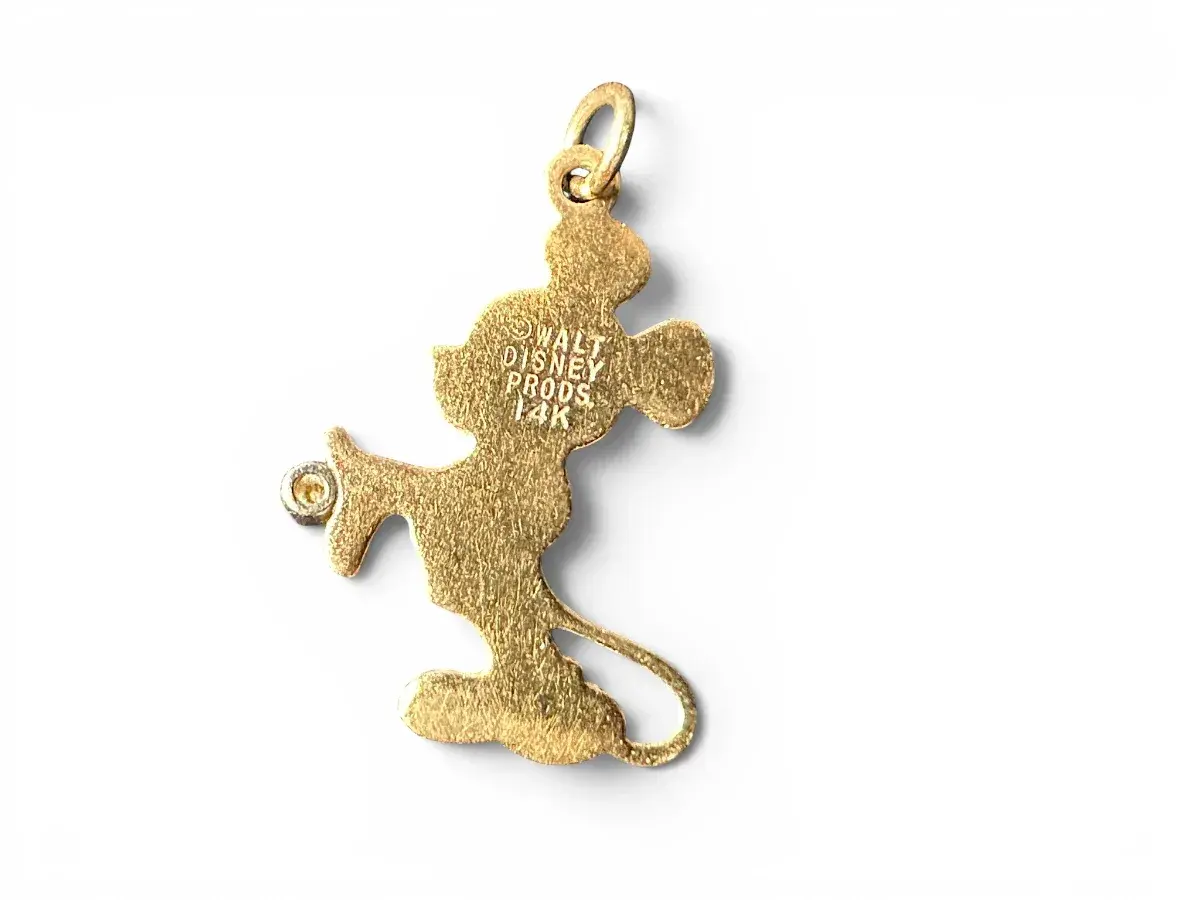
American gold is marked in karats: pure gold is 24K, so 14K is 14 parts gold in 24 — 58.3%. 10K (41.7%) is the lowest that can legally be sold as gold in the United States; 14K is the everyday standard, 18K (75%) the fine-jewelry standard, and 24K is bullion. The stamp is usually inside a ring, on the clasp tongue of a bracelet, or on the back of a pendant beside the maker’s name.
A "P" after the karat — 14KP, 18KP — means plumb: the gold content is exactly what the stamp says, not a rounded-up minimum. It is the mark sellers misread most often. The P is not "plated".
Tap or click any photo to expand it
Numbers: parts per thousand
Most of the world marks gold by fineness in parts per thousand. 585 is 14K, 750 is 18K, 375 is 9K, 916 is 22K and 999 or 999.9 is pure. European makers, Italian chains and nearly every designer house use the number — often with "Au", the chemical symbol for gold, in front of it.
Italian gold adds a maker’s mark in a lozenge or a star beside the 750, and chains carry the number on the small tag at the clasp. Bullion bars stamp the fineness, the weight and a serial number on the bar itself; the sealed card is the certificate, not the mark.
Tap or click any photo to expand it
A gold layer is not gold
The marks that cause the most disappointment are the ones with a karat on them that describe a coating. Gold-filled (GF) is a sheet of karat gold bonded over brass — legally at least 1/20th of the weight, and the fraction is usually stamped: 1/20 12K GF, 1/10 10K GF. Rolled gold plate (RGP) is the same idea, thinner. HGE is heavy gold electroplate, a few microns thick. GP, GEP and "24K gold plated" are thinner still.
Vermeil is gold over sterling silver, so it carries a 925 mark — the silver is real, the gold is a layer. Old watch cases say it their own way: "Guaranteed 20 Years" on a case back means gold-filled, the years being how long the maker expected the layer to last.
Tap or click any photo to expand it
British hallmarks
British gold has been hallmarked by an assay office for centuries, so a row of small marks is normal: the fineness (375 for 9ct, 585, 750, 916), an assay office — an anchor for Birmingham, a leopard’s head for London, a rose for Sheffield, a castle for Edinburgh — a maker’s initials, and often a date letter. Until 1999 gold also carried a crown.
9ct is real gold at 37.5% — the most common British standard and everyday jewelry across the Commonwealth — but it sits below the 10K American minimum, so it is priced on its actual gold content, not the karat.
Tap or click any photo to expand it
Designer marks and platinum
The great houses sign their work, and the signature sits beside the fineness. Cartier stamps its name, the ring size, Au 750 and a serial number; Tiffany & Co. its name and 750 — sometimes with the country it was made in, or a designer’s signature like Elsa Peretti’s; two-tone pieces carry both metals, 925 and 750. A signed piece can be worth far more than its gold, which is why we check every signature against the collector market before we weigh it.
PT950, PLAT or 950 is platinum, not white gold — heavier, purer and priced on a different market. It is the mark sellers overlook most often on a white ring.
Tap or click any photo to expand it
No mark does not mean no gold. Older rings, resized bands, worn chains and handmade pieces often carry nothing at all — and dental gold never does. We test unmarked pieces the same way as marked ones. Dental gold is sent out for testing before purchase, because its alloy cannot be read in the shop.
These are a small fraction of the marks that exist — thousands of makers, standards and imitations across two centuries. Identifying one properly takes a trained eye and the reference books, and more often than not a first attempt at home lands on plated mistaken for solid, or a signed piece priced as scrap. That is exactly what we are here for.
Keep reading
Ready for a Professional Evaluation?
Bring the piece — we will find the mark with you, test the metal, and explain a straightforward offer.