How to Read the Marks on Your Silver
E.P.N.S. and EPBM, the British lion, STERLING and coin silver, 925 and the world's numbers and symbols — what each one means for the value of a piece, with photos from silver that came through our Naples showroom.
Silver marks, explained
Reading the Marks on Your Silver
Almost every piece of silver carries a stamp somewhere — under the base, on the back of a handle, inside a rim. Those few millimetres tell us what the piece is made of, often where and when it was made, and sometimes who made it. Most of the marks below are on pieces that came across our own counter. Tap any photo to see the whole thing.
Marks come in every size and variation. The one on a teaspoon can be a millimetre tall, worn nearly smooth, hidden under a foot or inside a lid, or struck twice and half-legible. Finding and reading them is part of what we do — bring the piece and we will find the mark with you.
"EP" almost always means plated
EPNS is Electro-Plated Nickel Silver: a thin skin of real silver plated onto "nickel silver", an alloy of copper, nickel and zinc that contains no silver at all. EPBM is Electro-Plated Britannia Metal, the same idea over a softer tin alloy — common on Victorian and Edwardian teapots. EPGS (German silver), EP on its own, A1, "Silver Plate", "Quadruple Plate" and "Silver on Copper" all mean the same thing: base metal underneath.
These pieces can be beautiful and useful, but the silver on them is measured in microns, so they have little melt value. We buy plated pieces for their pattern, maker and condition, not their weight.
Tap or click any photo to expand it
The British lion
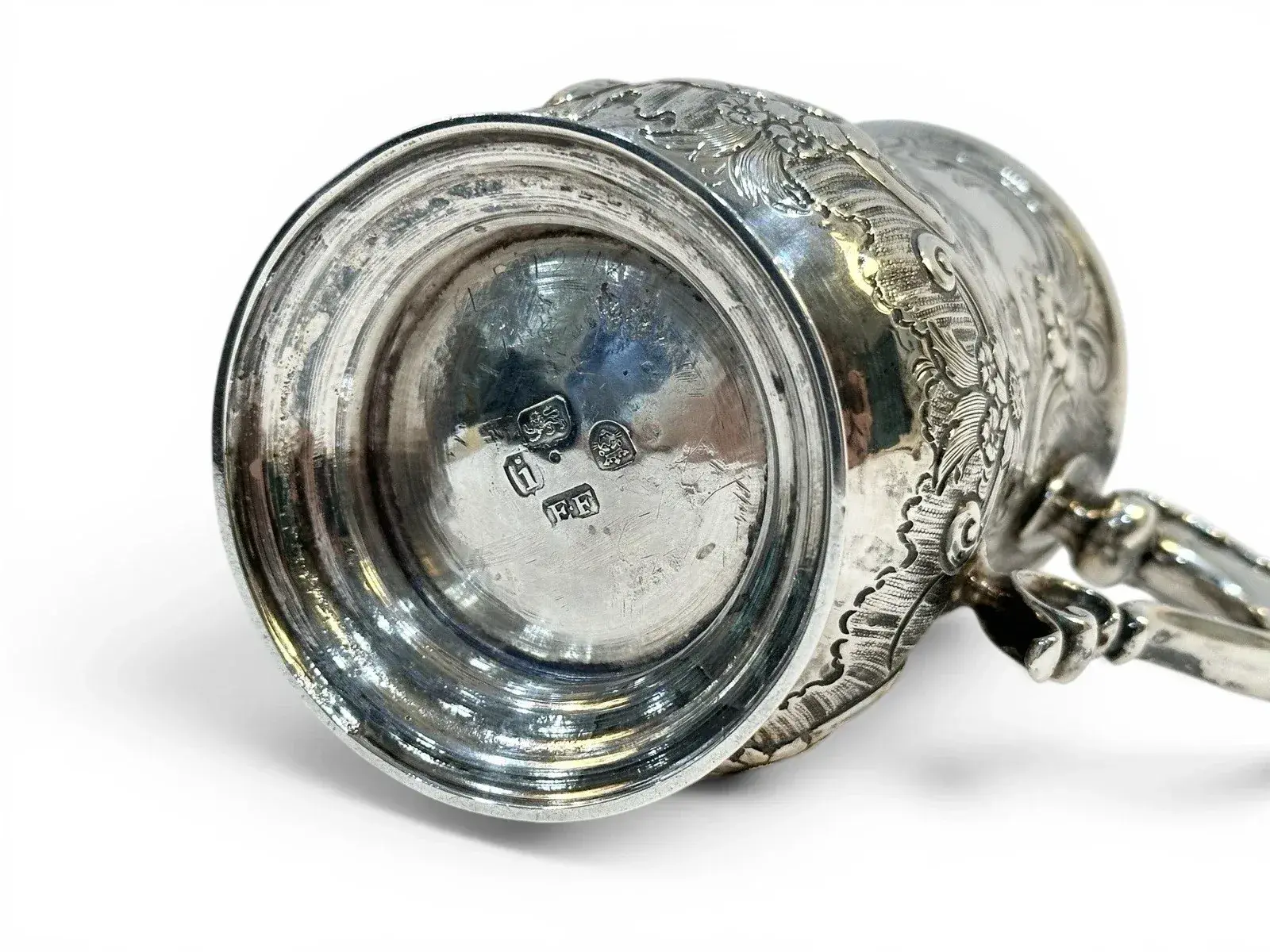
A small walking lion — the lion passant — has been the English mark for sterling since the 1500s. It is struck by an assay office only after the metal is tested, which makes it one of the most trustworthy marks in the world. It sits in a row with the others: the maker’s initials, the assay office (a leopard’s head for London, an anchor for Birmingham, a crown or rose for Sheffield), and a date letter that changes every year, which lets us date a piece to a twelve-month window.
Scottish silver uses its own standard marks — Edinburgh a thistle, Glasgow a lion rampant (rearing up) — so a lion on its hind legs is still sterling, just not English. A figure of Britannia in place of the lion means the higher 95.8% "Britannia" standard.
Tap or click any photo to expand it
"Sterling" — the American way
American silver was never hallmarked by an assay office. The maker stamps the word STERLING (92.5% silver) beside its own trademark, and since 1906 that word has been legally binding. So on American pieces the trademark is the thing to read: Gorham’s lion-anchor-G, Reed & Barton, Kirk, Tiffany, Wallace, and the retailers — a Philadelphia jeweler like J.E. Caldwell stamped its own name next to the maker’s.
Before "sterling" became the standard, American silversmiths worked to the coin standard (about 90% silver, the purity of melted coins) and marked pieces only with their name. Pattern numbers and dates ("PAT’D 1900") often sit under the word.
Tap or click any photo to expand it
925 and the other numbers
Most of the world marks purity as parts per thousand. 925 is sterling; 800, 830, 835 and 900 are the lower continental standards; 950 is the French first standard and 958 is Britannia. The number is what matters for melt value — an 800 piece contains about 13% less silver than sterling of the same weight.
Mexican silver adds a registration mark: an eagle with a number on older pieces, and since 1980 a letter-and-number code such as TU-62 for a Taxco workshop. Norwegian and Danish silver adds an S after the number (925S, 830S). A piece that mixes metals is marked for each — a sterling bracelet with 14K gold accents carries both 925 and 585.
Tap or click any photo to expand it
Less common and world marks
Some countries use a symbol instead of, or as well as, a number. Denmark’s three towers (the arms of Copenhagen) guaranteed at least 826 silver until 1961, when 830S and 925S took over; a Georg Jensen stamp is both a designer’s mark and a value mark. Japan’s 純銀 (jungin, "pure silver") promises fine silver near 999. Egyptian silver carries three small cartouches: the standard in Arabic numerals, an Arabic date letter, and a national mark — a cat on earlier pieces, a lotus flower later.
The French Minerva head guarantees 950 (a small "2" beside her means 800). Germany has used a crescent moon and crown with the fineness since 1888. Italian silver since 1968 carries a star with a maker number and province code. Scandinavian pieces read 830S.
These are a small fraction of the marks that exist — thousands of makers, cities and standards across four centuries, many of them look-alikes. Identifying one properly takes a trained eye and the reference books, and more often than not a first attempt at home lands on the wrong maker, the wrong country, or plate mistaken for sterling. That is exactly what we are here for: when a stamp is worn or unfamiliar, we find it in the references, and the metal itself settles the rest.
Tap or click any photo to expand it
Keep reading
Ready for a Professional Evaluation?
Bring the piece — we will find the mark with you, test the metal, and explain a straightforward offer.